
6000-9000 series
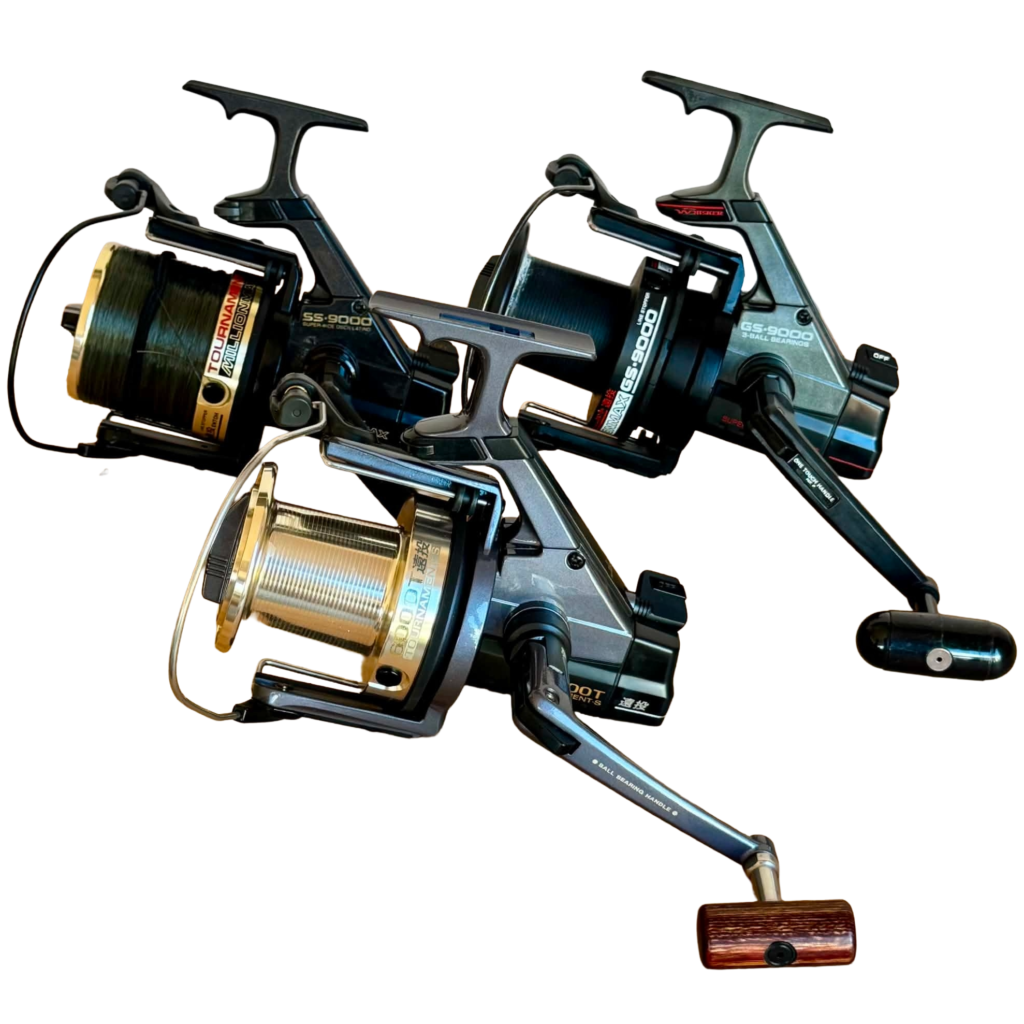
The 6000–9000 series is a small group of super long stroke reels, specifically designed for long distance casting with heavy lines. They are the largest Tournament models, built to withstand high loads and defined by their 45 mm stroke together with their spring-loaded 10 washer front drag.
The GS-9000 sits at the entry level and does not carry the ‘Tournament’ name, while the SS-9000 is the high-end model. The TS6000T is the successor to the SS-9000, while the GS-9000 never had a direct successor. In terms of technical features, the progression is GS, SS, TS.
In Europe they became very popular with carp anglers targeting big pits, thanks to their casting capabilities and high power. All models were sold in Europe, with the SS-9000 now being the most sought-after. The models were introduced between 1988 and 1996.
On this page, you will find general technical information. The reel is broken down into different segments presented in the order in which the reel is typically assembled. For detailed model info, click the models below.
Body assembly
The body is made of SiC Whisker reinforced carbon composite. The capsule design provides high torsional stiffness and protects from water and dirt. Two side covers and a rear cover are fitted, which is great for servicing. The rear covers on these reels differ from all other models, which are otherwise identical apart from colours and decals. A bail kicker is mounted on the reel stem. It pushes the bail back after casting if it has not been closed by hand. SS-9000 and TS6000T feature a roller in the bail kicker. Unlike the rear cove
Externally, the bodies are identical. Internally, the GS-9000 lacks wormshaft ball bearings, so its housing differs. So besides colours and decals, the SS-9000 and TS-6000T share a common body, while the GS-9000 has a different body. Compared with the 45-series bodies, the body is sturdier on the 6000–9000 models. A bearing retainer plate is required to hold the bearing in place, as the loads on the pinion gear can be significantly higher. Like the 45-series models, no pinion holder is used, due to the two bearings supporting the pinion gear.
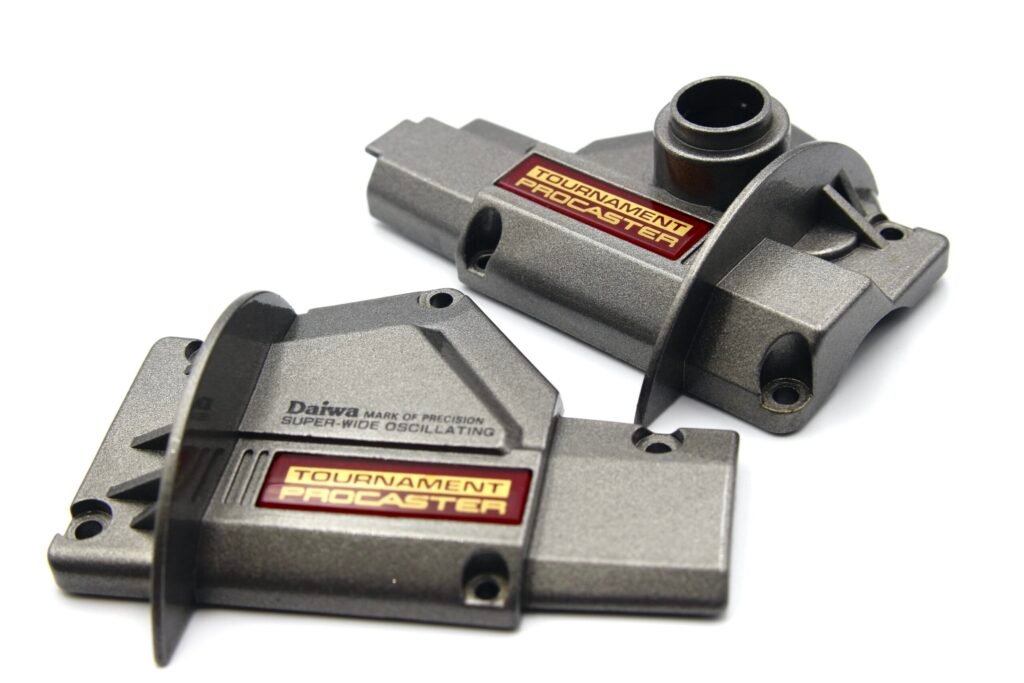
SS-45 side cover set, right-handed version
Anti-reverse
The anti-reverse mechanism is housed inside the body and uses a pawl that engages the ratchet on the pinion gear. When the anti-reverse lever (1) is activated, the pawl (2) is pushed down by a spring, locking the pinion (3) and preventing backward rotation. When the lever is off, it lifts the pawl together with a spring (4) on the drive gear, allowing the pinion gear to rotate freely in both directions. This ensures smooth and reliable operation. Make sure that the flat end of this spring is correctly seated in the recess of the anti-reverse pawl. Identical components are used for all three models, only the lever colour varies. It consists of the following main components:
- Lever (1)
- Pawl (2)
- Ratchet (pinion) (3)
- Pawl spring (drive gear) (4)

Anti-reverse on a TS6000T
Worm gear oscillation
Featured on all Tournament models and superior at the time to the many seen locomotive oscillation mechanisms. Daiwa marketed this as ‘flat winding system’. The worm gear oscillation translates rotary motion into an up-and-down movement of the spool, ensuring an even and smooth line lay. The pinion gear drives the worm shaft gear (1), which turns the worm shaft (2). The worm shaft is supported by bearings (3). As it turns, the oscillating slider (4) that is attached to the main shaft follows the grooves on the worm shaft via an oscillating pawl, translating this motion into the up-and-down movement. The wormshaft is made of duralumin and protected in a shield cover. Aside from the Thai bearings on the latest TS6000Ts, identical components are used for all three models. It consists of the following main components:
- Worm shaft gear (1)
- Worm shaft + shield cover (2)
- Ball bearings(3)
- Oscillating slider (4)

Worm gear oscillation on a GS-3000
The oscillating slider houses the oscillating pawl (5) in a bush (6) and tiny washer (7), secured by a cover plate (8). Two cover screws are installed with thread-lock, and are very tight when removed for the first time. Be careful, using the wrong screwdriver can easily damage them. The oscillating slider houses the following components:
- Oscillating pawl (5)
- Pawl bush (6)
- Pawl washer (7)
- Cover plate + screws (8)
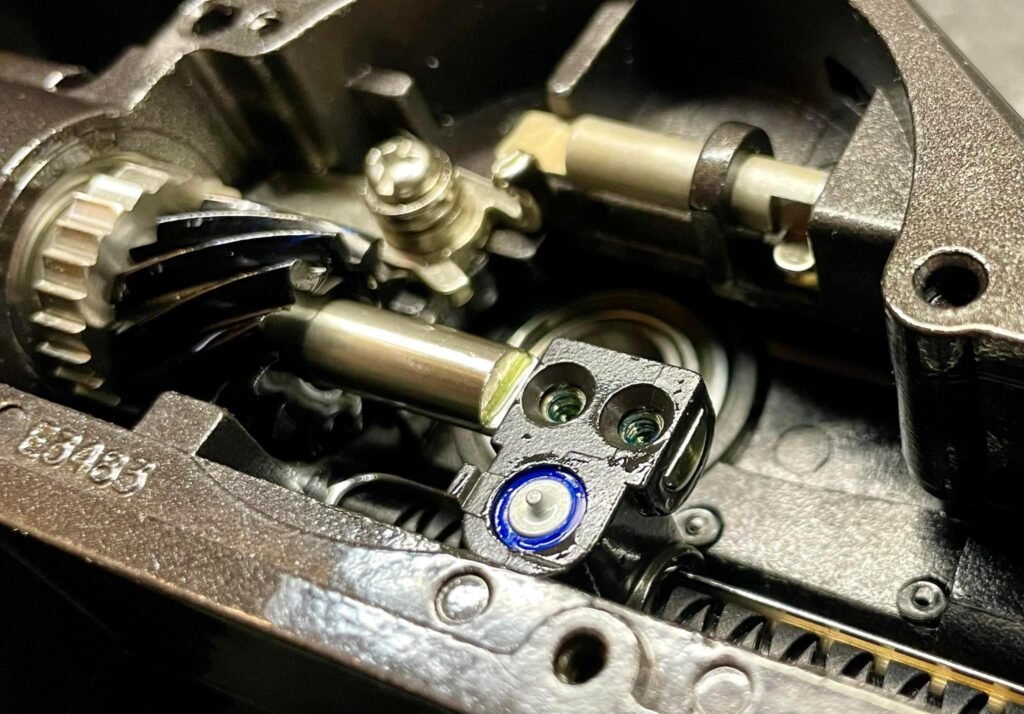
Oscillating slider components
Drive train
The drive train transmittes the power. All models use hypoid gears. The drive gear, powered by the handle, drives the pinion gear, which is directly connected to the rotor. In addition to rotating the rotor, the pinion gear also drives the worm gear oscillation system. Regardless of the handle position, the dentition of the drivegear is always to the left side of the pinion gear, so the rotor rotation is equal for both the left and right handle versions.
The gear ratio for the 6000-9000 series differs from the other models. As these were designed as heavy duty sea reels, the 3.4 : 1 gear ratio is a power ratio, sacrificing retrieval speed for greater cranking power. For every full turn of the handle, the rotor rotates 3.4 times, considerably lower then the 4.1 : 1 ratio on the other models.
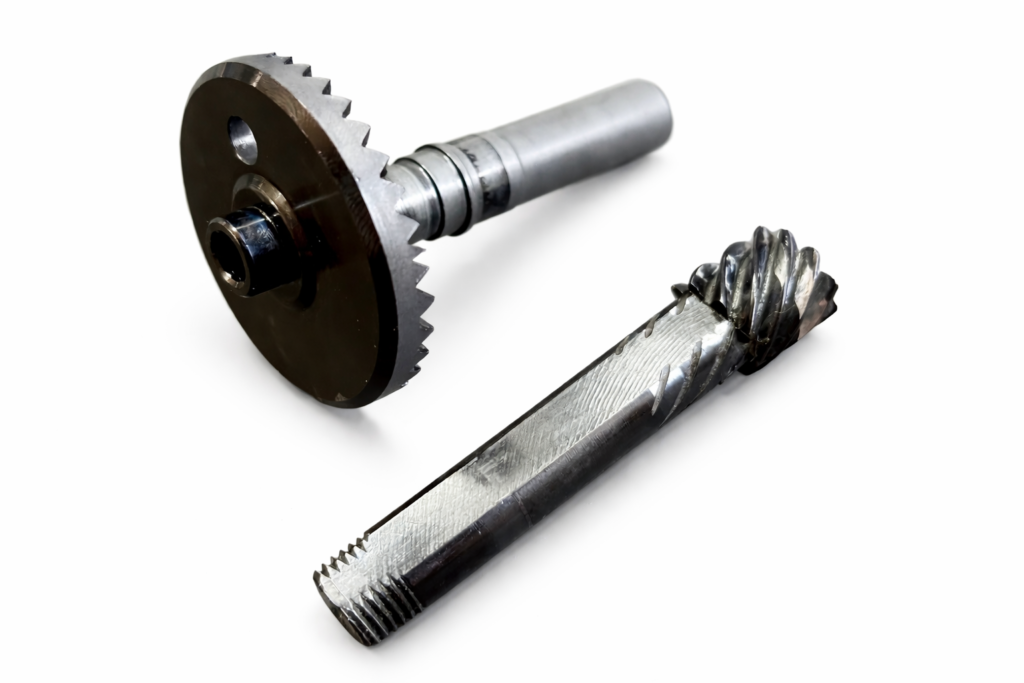
A used gear set (right-handed)
The drive train consists of two assemblies:
1: Pinion gear assembly
The pinion gear is made from super duralumin, a high-strength aluminium alloy, and finished in black almite (black anodised). The pinion gear is supported by two ball bearings, no pinion holder is used like on the 3000-5000 models. All three models use identical components, Z45T has an additional washer between the pinion teeth and the ratchet. It consists of the following:
- Pinion gear (1)
- Anti-reverse ratchet (2)
- Spacing sleeve (3)
- Ball bearing (4)
- Spacing sleeve (5)
- Spacer (6)
- Ball bearing (7)
- Bearing washer (8)

Pinion gear assembly on a SS-45
2: Drive gear assembly
The drive gear is also made from super duralumin and finished in black almite. All three models use a threaded drive type, as they are fitted with screw-in handles. Although the drive gears are identical across all models, they differ between left- and right-handed versions.
Right-handed models use a larger ball bearing on the handle side and a smaller one on the opposite side. Left-handed models follow the same arrangement, but include an adapter sleeve on the shaft end to allow the smaller bearing to fit opposite the handle. The two ball bearings supporting the drive gear are housed in the side covers. The assembly consists of the following:
- Drive gear
- Drive gear washer(s)
- Two ball bearings (different sizes)
- Anti-reverse pawl spring

Left-handed Z45T, note the adapter sleeve
Main shaft assembly
The main shaft lacks a click spring holder, as there is no drag. The spool washer (1) and main shaft washer (2) sit together. The 6 mm main shaft (3) is made of 85 % titanium alloy, light yet strong. All components are identical, except the main shaft, which has a different part number on the Z45T. It consists of the following:
- Spool washer (1)
- Main shaft washer (2)
- Main shaft (3)
- Rotor nut + holding plate (4)

SS-45 titanium alloy main shaft
Rotor assembly
The rotor assembly is attached to the pinion gear using a rotor nut, secured with a rotor nut holding plate. The rotor nut on these reels is right-hand threaded, so it loosens by turning anti-clockwise. The rotor assembly consists of a rotor, line guard system and bail assembly. Besides colours and decals, all components are identical for the three models, except for the bail assembly.
Rotor
The rotor is made from an aluminium alloy, just like the 3000–5000 series and unlike the 35 and 45 series, which use a lightweight titanium alloy. As with the 3000–5000 series, the line guard system is positioned opposite to that of the 35 and 45 series.
Line guard system
This system consists of a set of rollers mounted on the rotor, that run along a rubber ring on the spool. This prevents line hangups. Although very reliable, this system is notorious for the squeaking ‘coffee grinder’ noises. A drop of reel oil or PTFE spray on the line guard shafts usually fixes it. It consists of a set of the following components:
- Line guard roller shaft (1)
- Line guard rollers (2)
- Roller shaft nut (3)
The line guard shafts are mirrored compared with those on the 45 series, making them non-interchangeable.
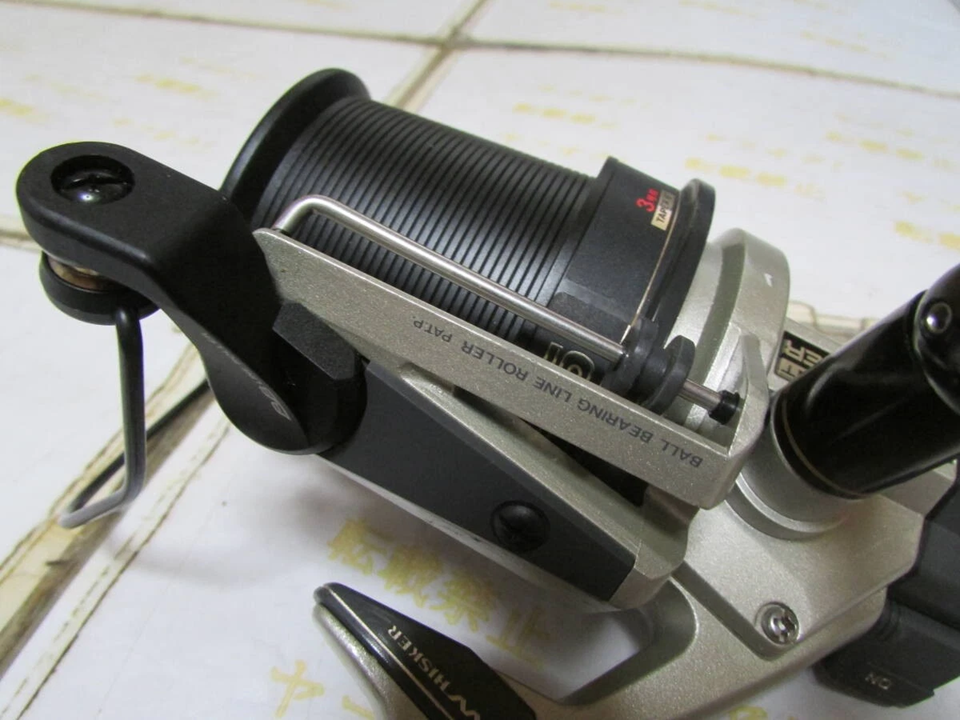
Line guard system on a ...
Bail assembly
The bail assembly, also called ‘Big roller system’ by Daiwa, is designed for extra strength. The bail arm and bail wire form a single piece (1), removing the line roller (2) leaves the bail in place. It features a line roller, secured with a large black or gold aluminium screw. An additional pin (3) is used to secure the bail to the rotor. Two bail arm screw retainers (4) connect the bail to the rotor. A coil spring in the rotor controls the opening and closing of the bail arm. It consists of the following components:
Bail (1)
Line roller components (2)
Bail arm screw (3)
Bail arm screw retainers (4)
Bail spring shaft (5)
Bail spring washer (6)
Bail spring (7)
Bail trip cover (8)
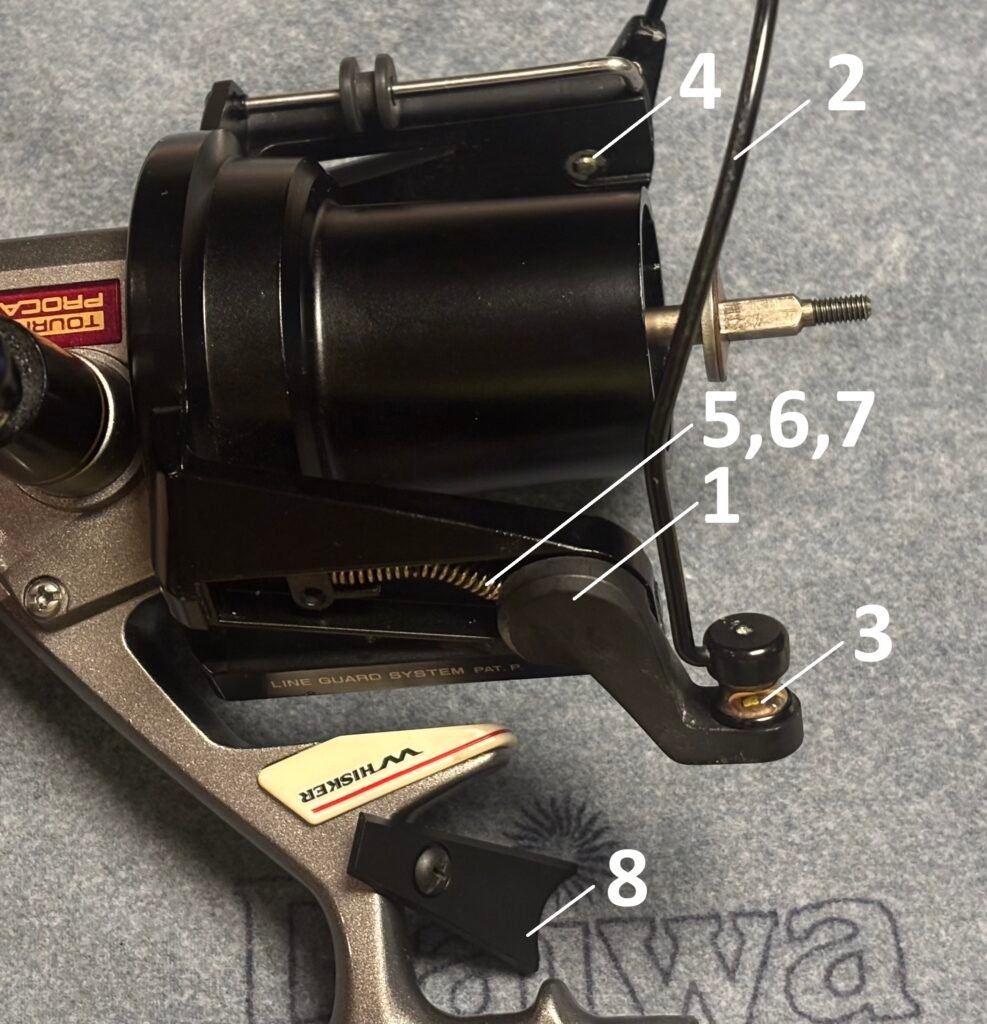
Bail assembly on a ...
The original GS-9000 and SS-9000 use identical bails and line roller components. They are fitted with black SiC (silicon carbide) U-type line rollers. The TS6000T uses a gold-coloured TiN (titanium nitride) coated Twistbuster line roller, dramatically reduces line twist according to Daiwa. The bail is also different on the TS6000T, meaning the SiC and TiN (Twistbuster) line rollers are not interchangeble without replacing the bail also. All line rollers run on bushes. These can be upgraded to ball bearings, but doing so requires replacing the original line rollers.
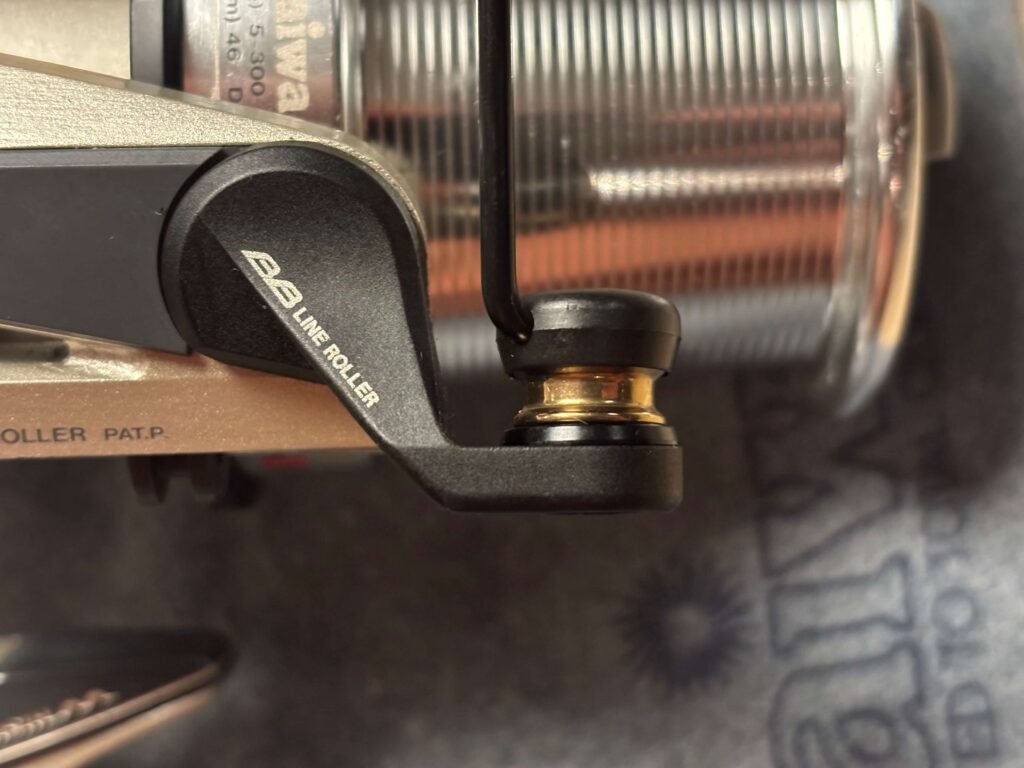
SS-9000 line roller
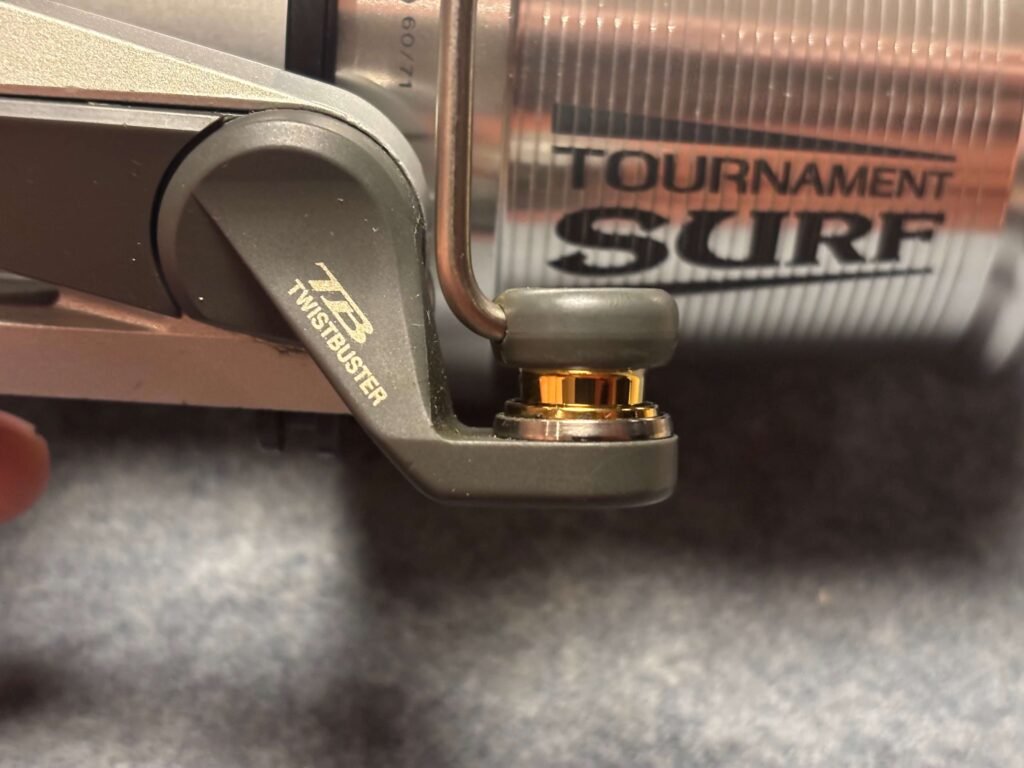
TS6000T line roller
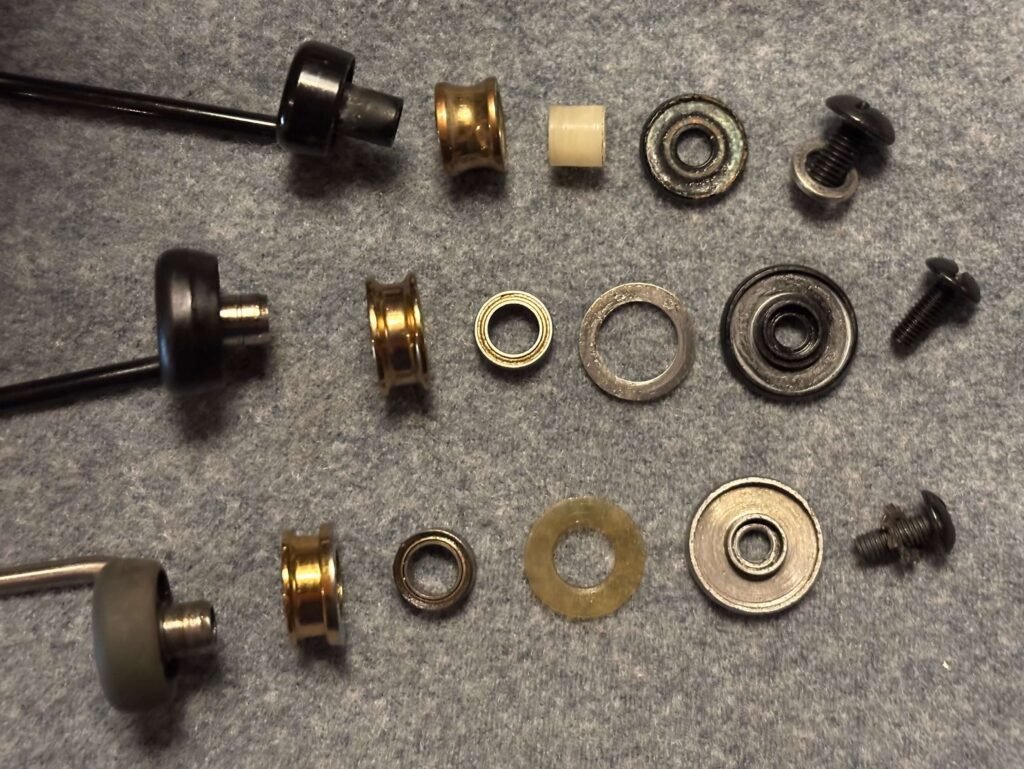
Line roller components of all three models
Spool and drag
As all reels in this group have a 45 mm stroke, the spools are interchangeble. They are made of anodised aluminium. All are optimized for distance casting, being long and tapered. The standard line clips are sturdy and suited for ‘hitting the clip’. Line capacity is equal for all models, and all came with a line reducer.
The drag system is mounted on the front of the spool and consists of five metal and five felt washers. The SS-9000 and TS6000T feature a click spring in the (spring-loaded) drag knob, producing the clicking sound when adjusting. The GS-9000 does not have this feature. This also means that its drag knob is not interchangeble with the other ones. The adjustment range is very wide, but can be converted to quick drag if desired.
LIJNCAPACITEIT CHECKEN

Daiwa SS45II reel and spools
Handle
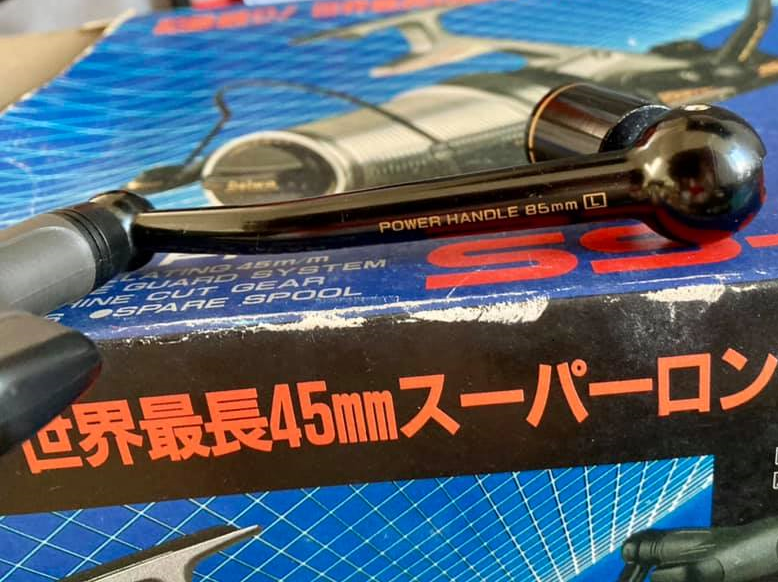
SS-45 handle (left version)
Handles on the 6000–9000 series are quite similar to those on the 3000–5000 series. A notable difference is the size of the handle knob, with these powerful reels using larger knobs than the 3000–5000 models.
The 6000-9000 series uses shaft-through handles. The shaft passes through the drive gear and is secured with a screw. These one-touch foldable handles can be folded with one hand and feature either a square or hex shaft. The SS-9000 and TS6000T have a wooden handle knob, while the GS-35 has a hard plastic torpedo knob. On the TS6000T, the handle knob shaft includes two ball bearings for smooth rotation. All handles are ambidextrous, so they can be mounted on either side.
Ball bearings
The pinion gear uses two large ball bearings (10×20×5 mm, ID×OD×width), just like the 45 models. The drive gear uses the same ball bearings, with two on all models except the GS-9000. Worm shafts bearings (4x7x2 mm) are used in all but the GS-9000. Handle knob bearings (5x8x2,5 mm) are only used in the TS6000T. As all 6000–9000 models use a one-piece bail assembly, no ball bearings are used in the line rollers.
The original SS-9000 and GS-9000 used Koyo bearings only, known for precision and durability. The later TS6000T can be found with both Koyo and Thai-made bearings.
Reels can be upgraded by adding or replacing ball bearings. On the GS-9000, the drive gear bushing can easily be replaced with a bearing for a noticeable improvement. Worm shaft and handle knob bearings cannot be added, while upgrading to line roller bearings require replacing the complete line roller. See the table below for an overview.