
How to reduce handle play by shimming
Most classic spinning reels have some degree of handle play. Reducing that play can make a reel feel noticeably tighter and smoother to use. In this article, I’ll show you how to do exactly that. It’s a simple tweak, but one that requires a bit of finesse, as there’s very little room for error. Get it right, however, and the improvement can be surprisingly significant for very little money.
What you will need
Required new parts:
- Drive gear adjustment washers
Required tools and equipment:
- Philips screwdriver PH1
- Flat screwdrivers
- 14 mm open-ended spanner
- Caliper (optional but useful)
Be careful: using too many or too few drive gear washers can seriously damage the gears. If in doubt, stick to the original washers.
Drive gear position

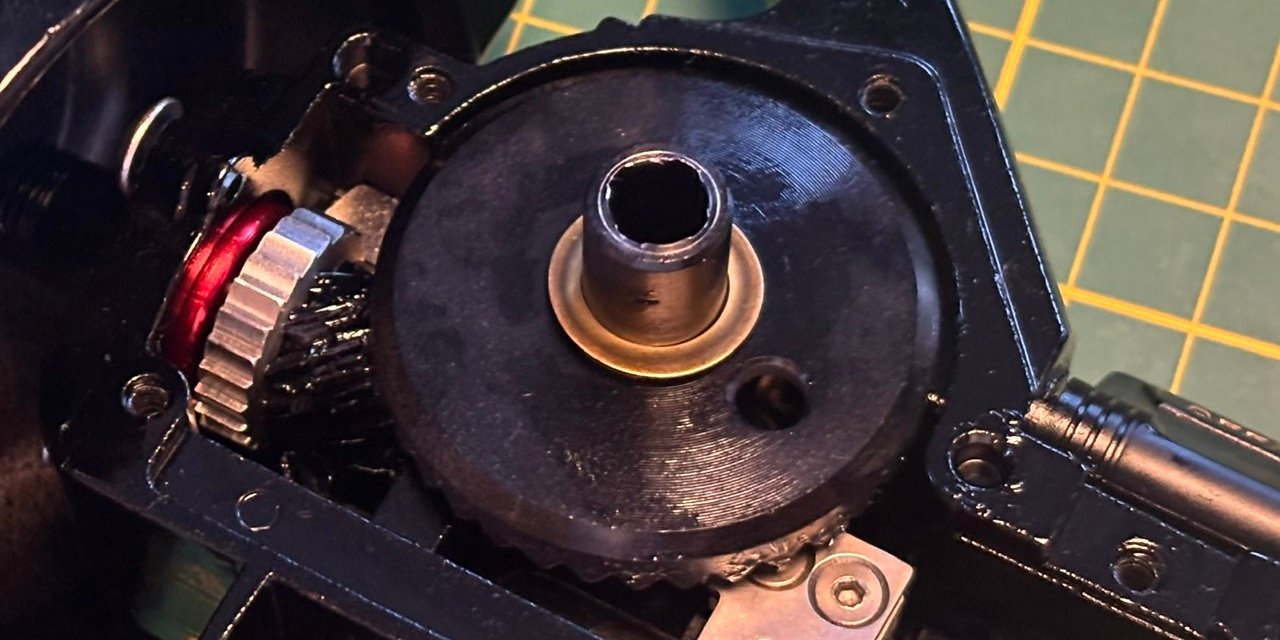
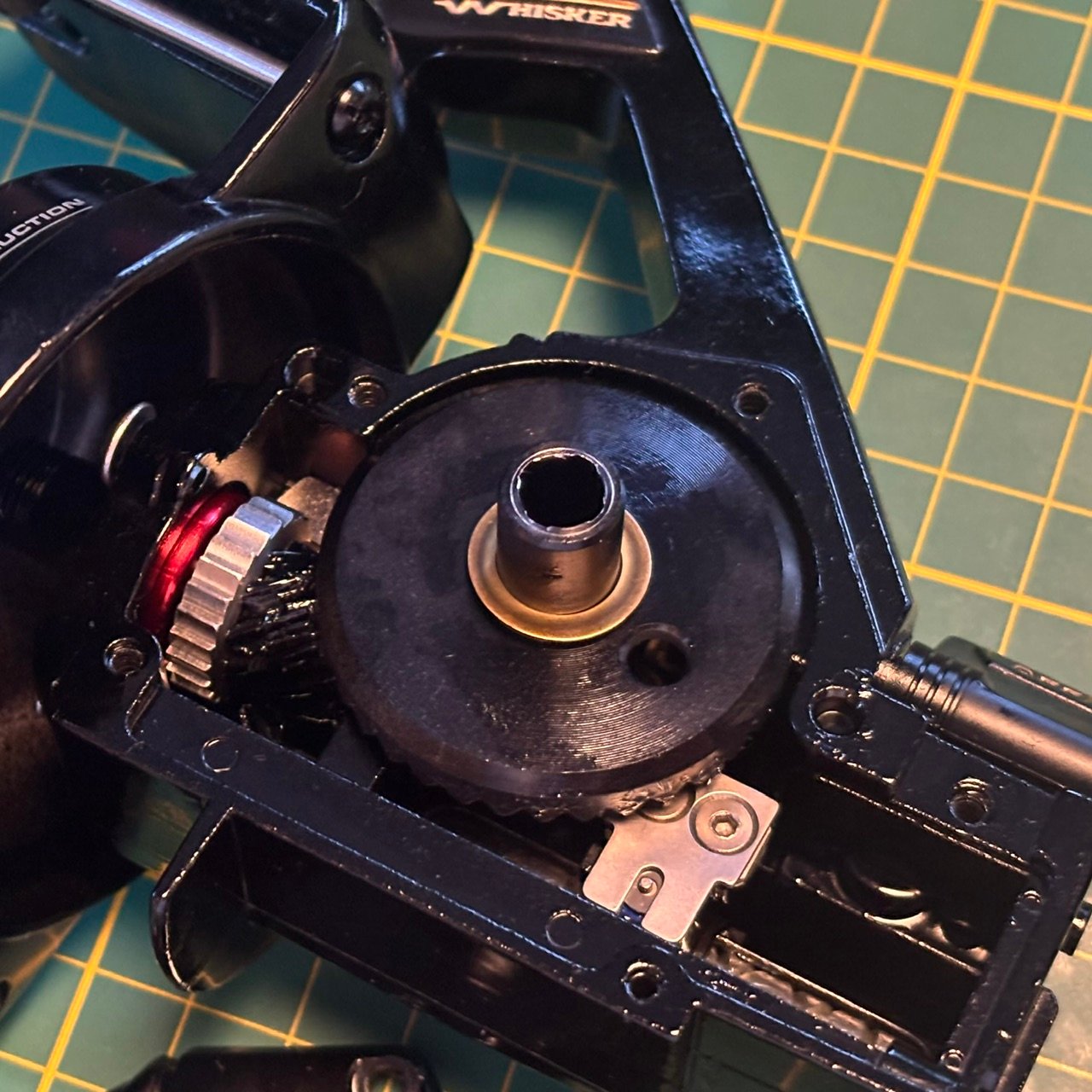
A 0.3 mm factory-fitted drive gear washer
If you’ve ever opened up one of your reels, you might have noticed one or more washers fitted between the left-side bearing and the drive gear. These are known as drive gear washers. By determining the position of the drive gear relative to the pinion gear, they control how closely the gears mesh. This gear set transfers the rotation of the handle to the rotor, making correct gear meshing essential.
Too much clearance increases wear because the drive gear teeth only make limited contact with the pinion. Too little clearance has the opposite effect, forcing the gears together too tightly, making the reel feel heavier to turn and accelerating wear. In both cases, you’ll often hear a humming noise. From the factory, the gear mesh is usually set within a fairly safe tolerance. This provides a practical balance between smooth operation, reliability, service life and production costs. On many classic reels, the standard drive gear washer stack is around 0.3 mm thick. While this approach is safe, it often leaves a noticeable amount of play in the handle.
Drive gear shimming

....
Shimming allows the gear mesh to be fine-tuned for each reel by adding extra washers to adjust the position of the drive gear more precisely. This reduces handle play and can make the reel feel noticeably tighter and smoother. However, care is needed to ensure reliable operation under different conditions.
Some reels may require as much as 0.8 mm of additional shimming, although the amount is generally lower. Suitable washers are available from various suppliers such as Gato Custom Reels. A digital caliper helps measure the washers and determine the combination required.
To begin, remove the handle, spool and left side cover. Once inside, remove the bearing and add the required washers. Each adjustment requires the reel to be reassembled and tested, so finding the right setting involves some trial and error. Take your time and make small changes between tests.
Checking the correct gear mesh
.....
The first thing to check is the remaining handle play. Ideally, it should be almost eliminated, but a tiny amount of movement should remain. If not, the reel will become harder to turn as the drive gear presses too firmly against the pinion gear.
When you’re close to the ideal adjustment, this can be difficult to judge. A simple test I use is to remove the spool and position the handle pointing forwards, with the line roller near its highest point. The handle should then fall under its own weight. If it doesn’t, the gear mesh may be too tight. This test is only useful if the handle behaved this way before shimming.
The final clue is noise. A properly adjusted gear mesh should produce no strange noises. If the reel still makes a noticeable humming or whirring sound during rotation, further adjustment may be needed. However, this only applies if the reel was quiet before shimming, as other issues can cause these sounds.